
She-ra's TPLO Surgery
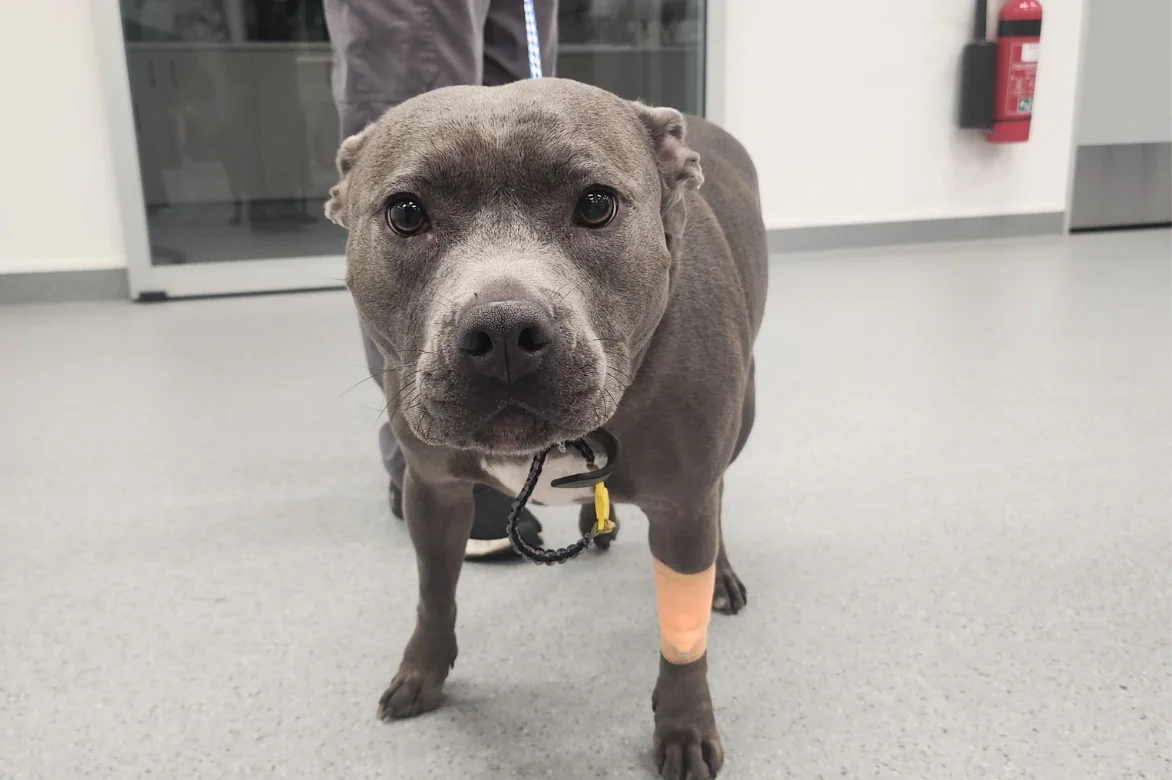
She-ra, a 3-year-old English Staffordshire Bull Terrier, faced a tough challenge when a minor fall at home led to severe lameness in her right hindlimb.
Lameness is a term used to describe when an animal is unable to put weight on a limb or moves with difficulty due to pain or injury. She-ra had been dealing with intermittent lameness in her leg for a few months, but the fall made her condition much worse. Her family brought her to ARH Minchinbury, where the team quickly assessed her. They found that She-ra was not putting any weight on her right leg and performed a thorough examination, including sedation and radiographs.
The results showed a cranial drawer in her right stifle join – that is, abnormal movement in the knee joint. They also found joint swelling and degenerative changes, indicating damage and wear in the joint. To address these issues, the team decided on a surgery called a Tibial Plateau Levelling Osteotomy (TPLO), along with an arthrotomy (surgical incision into the joint). The surgery was performed by ARH Minchinbury’s Small Animal Specialist Surgeon, Dr Kyle Song. During the procedure, the discovered that She-ra’s medial meniscus (a cartilage pad in the knee) was torn and had to be removed, and the cranial cruciate ligament was nearly completely ruptured.
What is a TPLO?
A Tibial Plateau Levelling Osteotomy (TPLO) is a specialised surgical procedure used to treat dogs with a torn cranial cruciate ligament (CCL), which is similar to an ACL tear in humans. The TPLO procedure involves altering the angle of the tibial plateau (the top surface of the shin bone) to reduce the strain on the knee joint and improve its stability. This surgery is often recommended for pets with severe CCL injuries to restore normal function and alleviate pain.
The surgery went smoothly, and She-ra woke up well from anaesthesia. She stayed at the hospital overnight, where she received fluids, pain relief, and antibiotics to help her recover. The next day, she went home for continued care, with strict instructions to rest and take pain medications.
At her 2-week check-up, She-ra was already showing signs of improvement. Her lameness was less noticeable, and her surgical wound was healing nicely. Her family began introducing short walks into her routine to help her regain strength.
By her 10-week follow-up, She-ra was doing exceptionally well. She had no signs of lameness or discomfort, and radiographs showed excellent healing at the surgery site. She was gradually allowed to return to her regular exercise routine.
She-ra’s recovery story highlights the incredible resilience of pets and the importance of timely, specialised veterinary care. Thanks to the dedicated team at ARH Minchinbury and the loving support from her family, She-ra is back to her happy, active self, enjoying life to the fullest.
Know your nearest emergency vet
Pet emergencies can happen at any time. The Animal Referral & Emergency Network has emergency vets available 365 days a year, including public holidays. Find your nearest location here.
You can read more of our specialist veterinary news and stories here.
For referring vets, please use our online referral form to submit a case enquiry.
You might also be interested in
Catastrophic Error - I had amputated a normal leg
Charles Kuntz recounts a case where he amputated a dog's leg based on a suspected osteosarcoma diagnosis, which was initially refuted by biopsy but later confirmed by top pathologists. The dog lived over three more years, exceeding typical survival expectations.
Axial Pattern Flaps
Uncover the ins and outs of Axial Pattern Flaps surgery. Understand flap surgery types, techniques such as Z-plasty, and post-operative care essentials.
Drivers for progress in veterinary surgery
Veterinary surgery is progressing at a very rapid rate. Dr Charles Kuntz shares factors which have contributed to this rapid progress.
