
Daschunds & Pes Varus
Pes varus is a developmental condition that results in a limb deformity and is seen most commonly in dachshunds.
In Latin pes means foot and varus means inward. As affected puppies develop, the inside part of the growth plate at the end of the shinbone doesn’t seem to grow as quickly as the outside and the leg begins to bend inwards.
Initially, Pes varus may present as a slight limp but as a puppy grows owners will often start to notice a more obvious lameness in one or both legs. Dachshunds with Pes varus are often noted to ‘walk like a cowboy’, and the deformity can affect both the ligaments of the ankle and the position of the kneecap.
The average age at diagnosis is approximately eight months and dachshunds can have either one or both legs affected. Dachshunds’ short legs mean that sometimes a diagnosis isn’t obtained until they are much older. The average deformity seen at ARH is approximately 35 degrees, with the worst being 50 degrees!
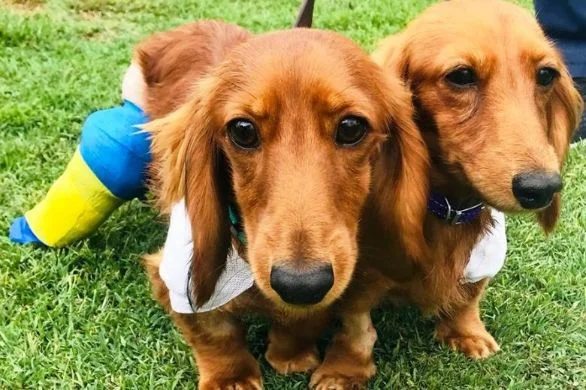
Millie and Alfie’s story
Millie and Alfie are an 11 month old brother and sister duo who recently visited our specialist surgeon, Dr Lance Wilson, with Pes varus.
Their owners had noticed that Alfie in particular had a twisted right back leg. Millie’s left leg was also looking unusual, however Alfie’s was easier to pick up as he is bigger.
Dr Lance used a technique known as an opening wedge osteotomy. He made a cut in the bone at the level of the deformity, only 6mm above the ankle joint, corrected the deformity and held it in place with a hybrid external skeletal fixator. The surgery was performed under fluoroscopic (x-ray) guidance and a bone graft was placed in the defect to encourage healing. Dr Lance likes this technique as it allows him to make the correction right where the deformity occurs, allowing for a very accurate re-alignment.
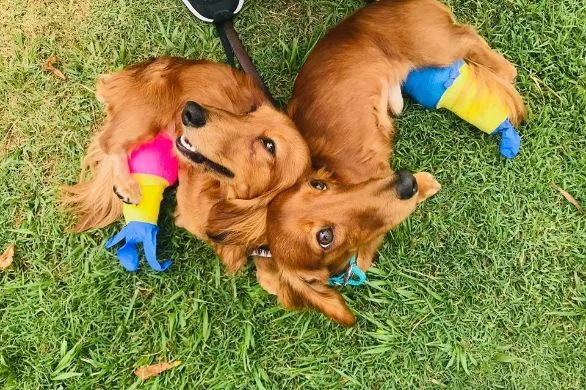
The frame applied is strong and tolerated well by dachshunds. It is removed when the bone has healed.
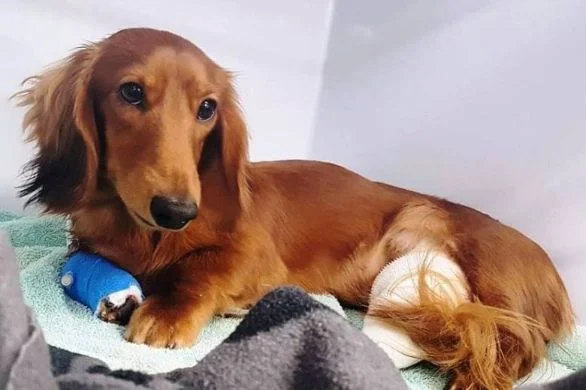
In Alfie and Millie’s case, they wore their frames for six weeks and once removed their affected hind limbs were the same as any other dachshund. Both dogs have been able to move freely and happily, and are back to enjoying life as playful puppies.
Our surgery team sees a significant number of Pes varus cases each year. While it is relatively uncommon, early detection and correction allows for a shorter healing time and reduced potential for secondary issues.
You can read more of our specialist veterinary news and stories here.
For referring vets, please use our online referral form to submit a case enquiry.
You might also be interested in
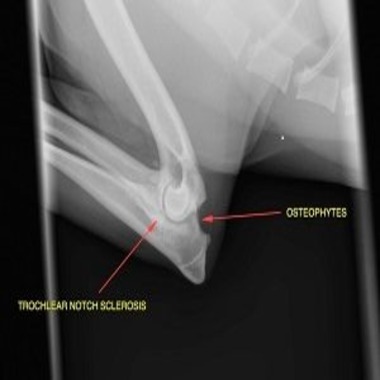
Elbow Dysplasia in Dogs and Medial Coronoid Disease
Learn about Elbow Dysplasia in dogs, what does elbow dysplasia look like in dogs, treatment and diagnosis from our expert Veterinarians.
Vestibular Disease in Dogs | Animal Referral & Emergency Network
Discover expert tips on treating older dogs with vestibular disease from the specialists at the Animal Referral & Emergency Network.
Cataracts In Dogs | Causes, Symptoms & Treatment
Discover everything you need to know about cataracts in dogs. Learn about causes, symptoms, and effective treatments to safeguard your dog's eye health.
